Exhibition Rooms on the Piano Nobile
The visitor route, completely redesigned and expanded in 2013, unfolds through twenty rooms on the first piano nobile.
The display combines the palace’s original furnishings and paintings with numerous works drawn from various collections and storage holdings of the Civic Museums of Venice.
Portego
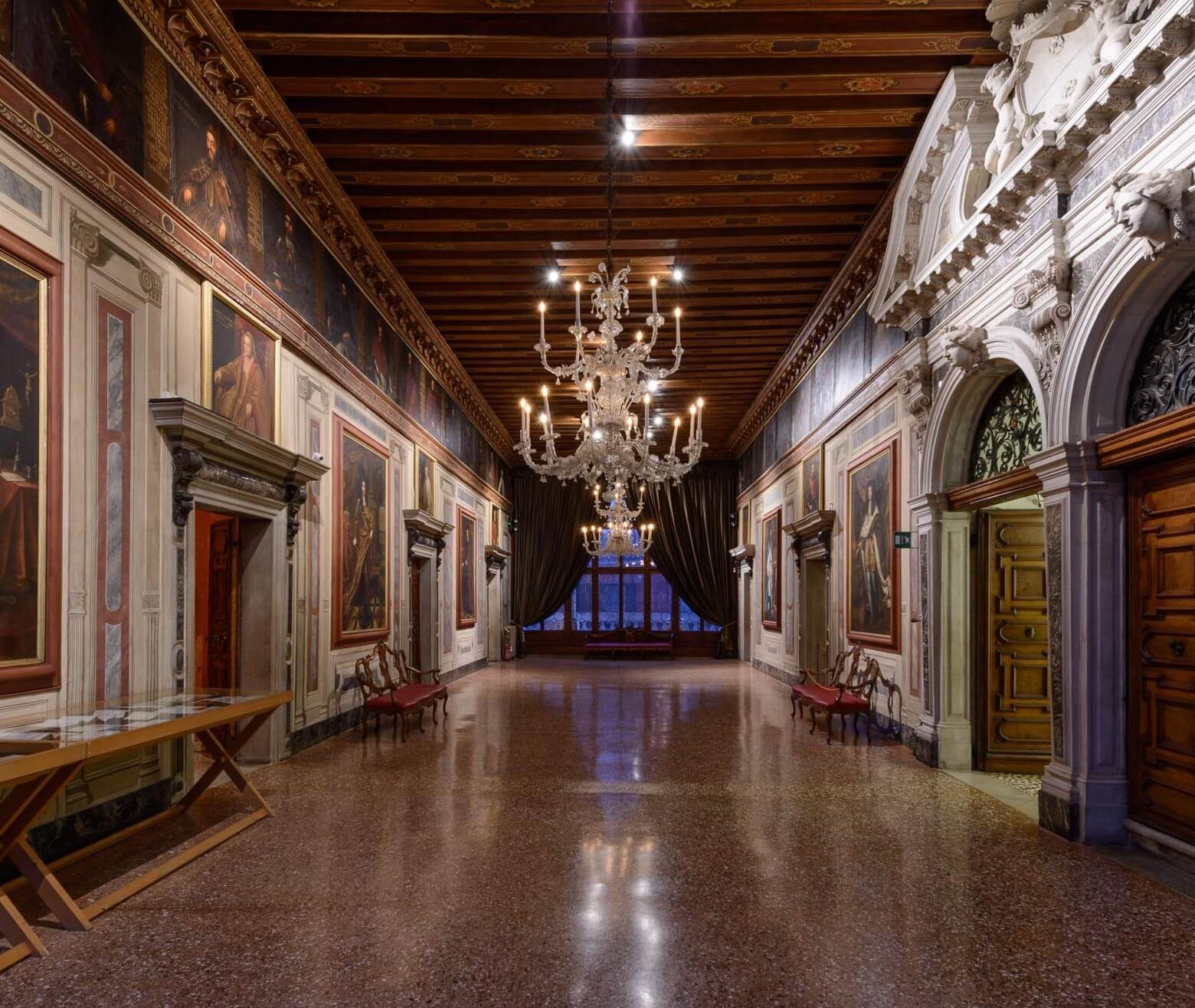
Portego is the term for this large central hall around which the other rooms are arranged and linked, and it is typical of the architecture of Venetian palaces. Intended for the festivities and ceremonial life of the family, it features a monumental double marble portal surmounted by a broken tympanum with the Mocenigo coat of arms in the centre, supported by two cherubs, a motif found scattered throughout the palazzo, especially in the paintings and carved into the upper part of the picture frames.
Large paintings hang on the walls, mainly depicting illustrious personalities to whom the Mocenigo family were ambassadors, while the long frieze running under the ceiling, modelled on the one in the sala del Maggior Consiglio (Great Council Chamber) in the Doge’s Palace, recalls the illustrious members of the family. This is accompanied by short captions narrating the highlights of their careers. The short sections of wall not covered by the paintings are instead decorated in fresco with architectural motifs created originally by the quadraturist (painter of illusionistic ceilings) Agostino Mengozzi Colonna, but later repainted.
Room 1
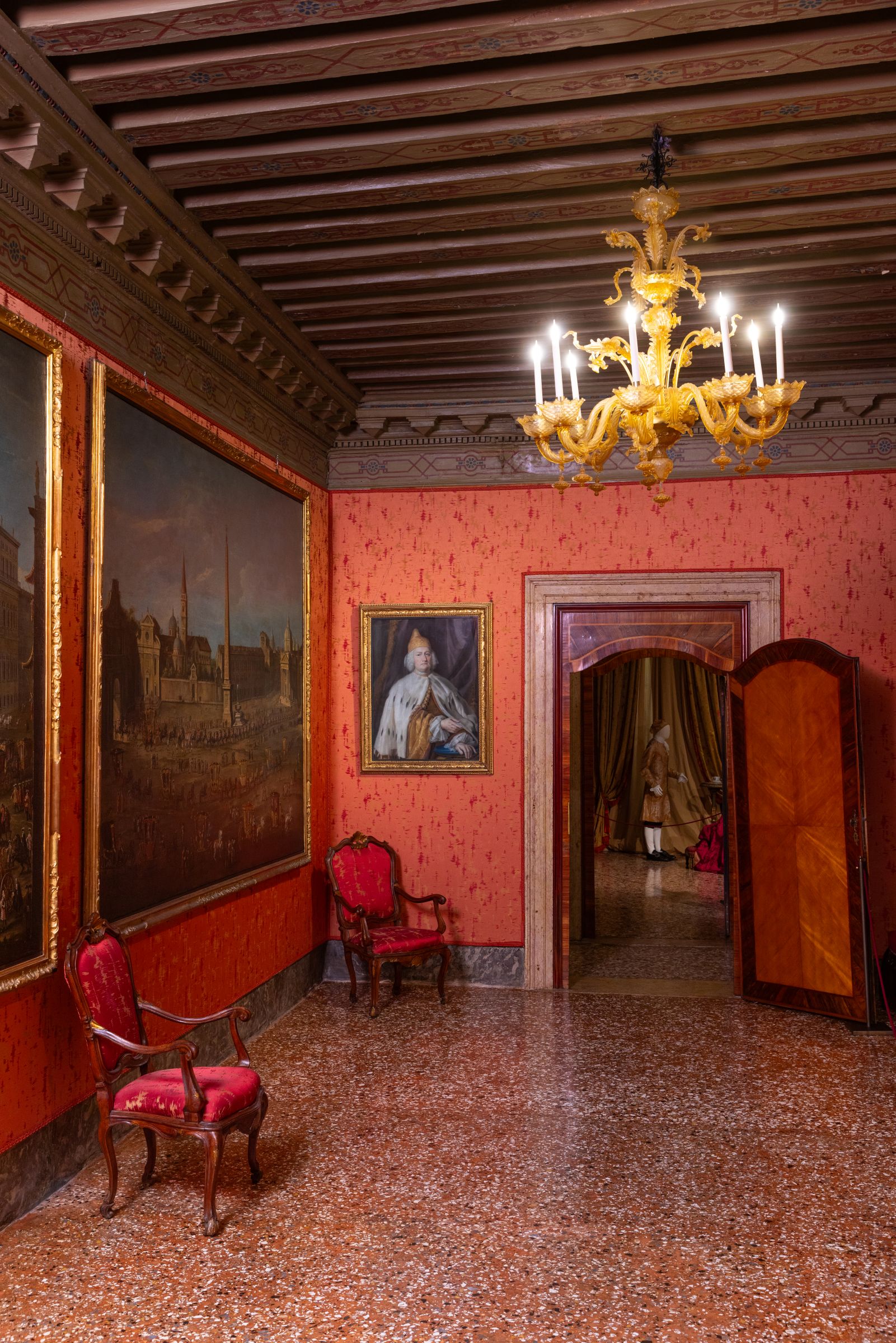
The paintings in this room, part of the original nucleus of works of art belonging to the Mocenigo di San Stae family, inaugurate a pictorial series displaying celebrations of the family’s glories.
The two solemn paintings relate to commemorative episodes from the career of Alvise IV Mocenigo (1701-1778), who lived in Rome from 1733 to 1737 as ambassador to Pope Clement XII. The pictures are by Antonio Joli, a vedutista – painter of views – whose stylistic hallmark lies in the use of imposing architecture contrasting with minute, swarming figures, which accentuate the scenographic perspective of his scenes. The three delicate portraits instead bear witness to the career advancement of Alvise IV Mocenigo himself, elected doge in 1763, and depict the dogaressa Pisana Corner, his wife from 1739, and the probable portrait of one of the doge’s three brothers. These paintings by Francesco Pavona, with their billowing and almost impalpable pictorial rendering, are a testimony to the popularity of pastel portraits in the eighteenth century, both in Italy and abroad.
Room 2
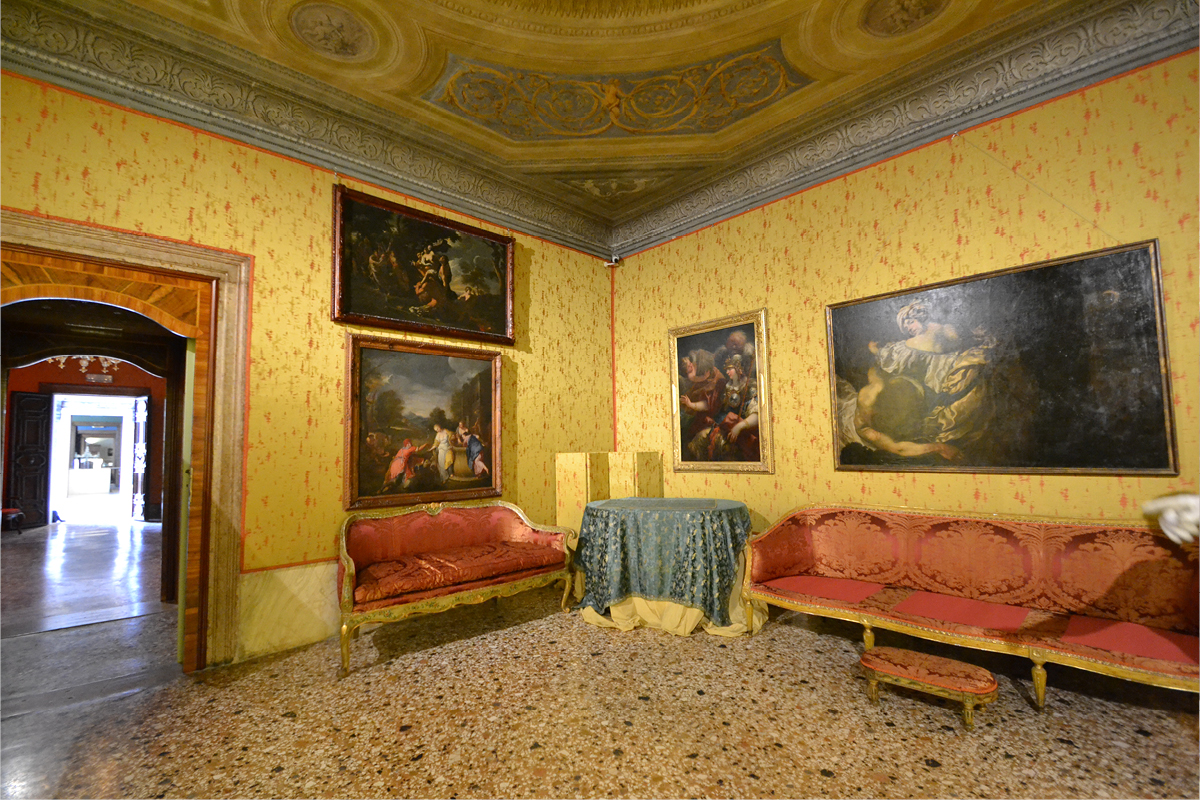
The allegorical fresco on the ceiling is, like those in the subsequent rooms, the result of a major decorative intervention carried out in 1787 for the prestigious wedding between Alvise I, nephew of Doge Alvise IV Mocenigo, and Laura Corner di San Polo. Arranged in a pyramidal arrangement we see Fame bearing an olive frond and trumpet, Glory on a cloud with sceptre and crown and Hymenaeus, a nuptial symbol carrying torch and garland, surrounded by fluttering cupids with amphora and oar, probable symbols of abundance and fortune in maritime undertakings. A young man holding the alchemical symbol of Mercury concludes the scene in the foreground. This central scene in the style of Tiepolo is the work of Giovanni Scajaro. It is set within a frame of neoclassical taste created by the quadraturista Giovan Antonio Zanetti; a quadraturista was an artist who, in the seventeenth and eighteenth century, specialised in the creation of wall paintings with perspective and illusionistic architecture using both tempera and fresco.
Complementing the eighteenth-century aesthetics visible throughout the palazzo are a series of graceful pieces of furniture counterbalanced by a sturdy, tough chest of the same period. The exotic Chinese porcelain from the treasury of the Venetian Scuola Grande di San Rocco, on the other hand, is the result of a loan.
Room 3
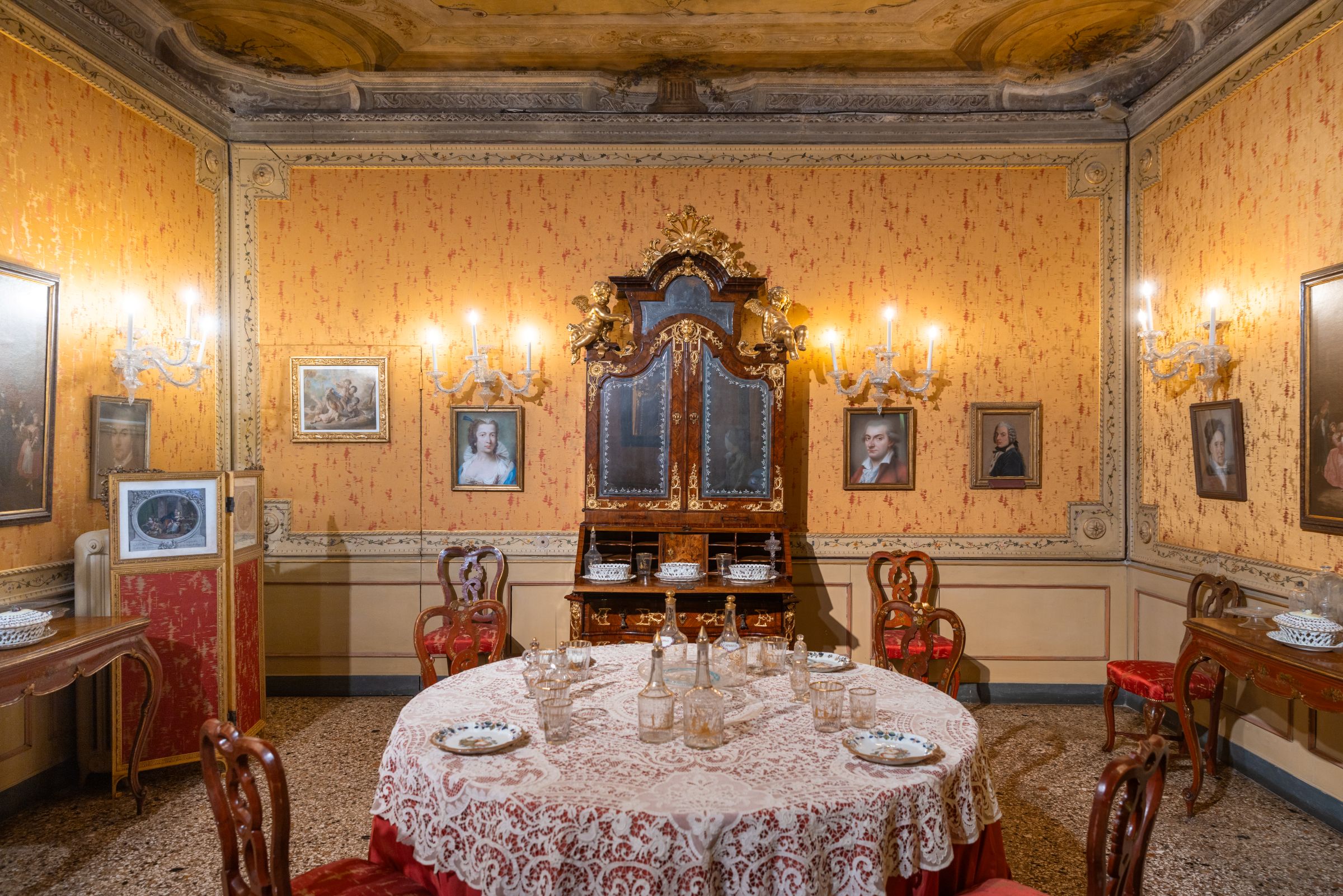
An eighteenth-century table service is displayed in this room, combining Italian ceramics with Venetian-made glass, much of it in the Bohemian manner, a production imitating the shiny, thick Bohemian crystal, particularly suitable for engraving and grinding, and sometimes painted with gold.
The scene frescoed on the ceiling is dominated at the top by Glory with a pyramid, palm frond and laurel wreath, while in the centre a warrior appears on a chariot drawn by swans and winged cherubs, followed at the side by Fame blowing a trumpet. The two female figures with sword, olive branch, sceptre and stacked weapons can be interpreted as the personifications of successful military undertakings or as Venice and Peace. Finally, two women appear holding a fruit and two oars, allegorical figures of the Earth and the Sea. The frescoed frame enclosing the scene features a double slender floral trellis, also repeated in the woodwork, and a frame of monochrome medallions depicting the Arts.
Room 4
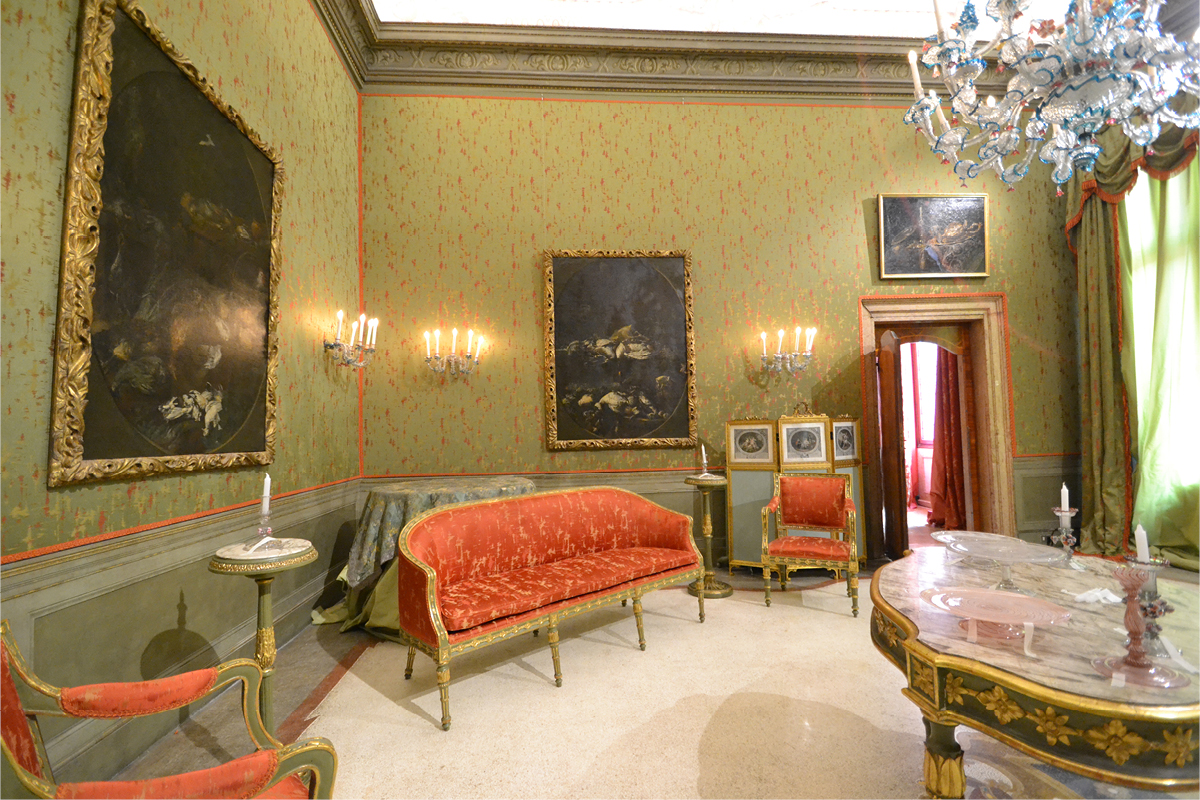
Of the paintings on display here, only the Madonna attributed to the school of Bellini is part of the original nucleus of works belonging to the palace, as are the chandelier and the wall sconces of eighteenth-century Venetian manufacture with their characteristic a ciocche polychrome flowers.
In the centre of the floor, in Venetian-style stucco, there is the coat of arms of the Mocenigo family, while the ceiling fresco presents an allegory of weddings with Hymenaeus, equipped with a torch, on a chariot followed by the Hours, represented by putti with butterfly wings holding two doves. This is followed by the bride almost struck by a dart fired by Venus, while she is holding an already pierced heart. The other figures represent Poetry, Love and Spring, while in the foreground lies Abundance with cornucopia and cupids on a cloud.
The fresco is completed with allegorical medallions representing Poetry, Painting, Sculpture and Music.
Room 5
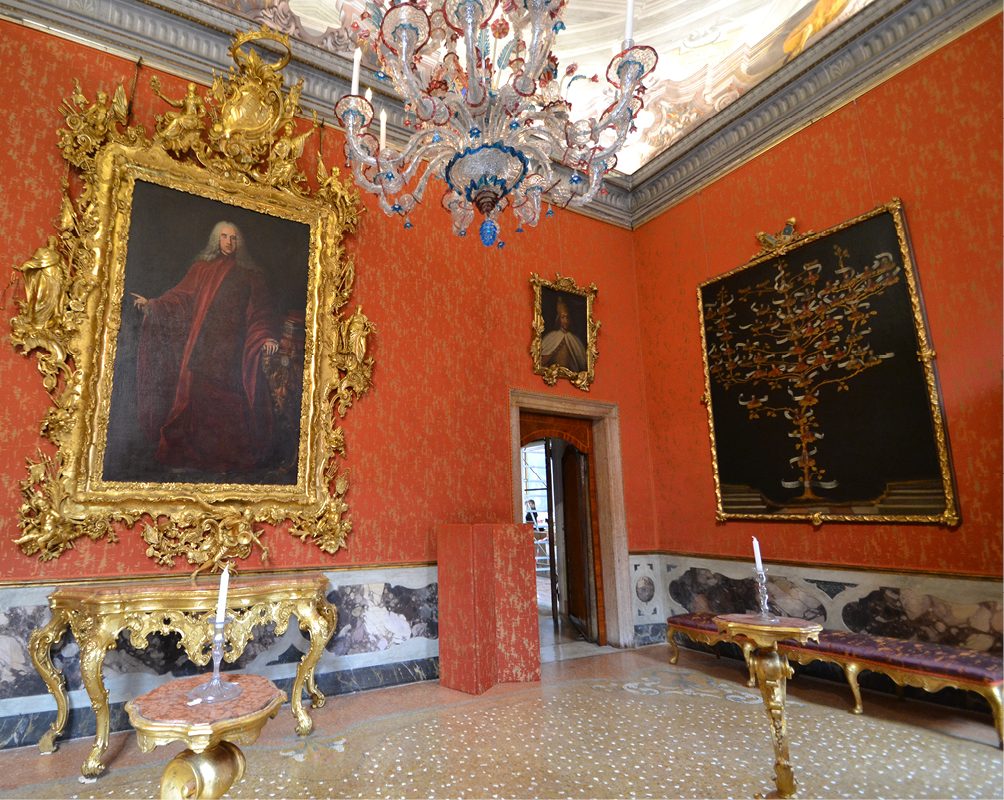
A well-known episode in the martial achievements of the Mocenigo family is depicted in the large canvas commemorating the clash near the Greek island of Sapientza between the Barbary pirates and the Venetians led by Zaccaria Mocenigo (1634-1665), who is said to have preferred to die by setting fire to his ship rather than fall into the hands of the enemy.
It is worth noting the elaborate gilded frame with coat of arms and allegorical figures in the round, and the chandelier, which, like the one in room 4, is attributed to the workshop of Giuseppe Briati (1686-1772), who was a member of a family in which the art of glassmaking had been handed down for generations.
The fresco on the ceiling shows Metaphysics, a winged figure with the sun in her breast, holding Family by the hand. Two figures with symbols of political and religious power follow, alluding to the offices held by members of the Mocenigo family. Justice with scales, Peace with an olive tree and a putto with a laurel wreath also appear. Fortitude and Martial Virtue, with column and shield, end the list, while in the top left two figures can be identified as the culmination of the apotheosis.
Room 6
This small, intimate and welcoming room, set like a gem within the mighty and celebratory palace, reveals a treasure-chest-like eighteenth-century stucco decoration in soft, gentle pastel tones, reflecting the bright and proverbial light-heartedness of that century.
Among the slender pieces of furniture, all dating back to the eighteenth century, the wooden chest covered in leather and silk stands out for its rarity and refinement. It was intended for wealthy Venetian patricians in which to keep their precious wedding dowry; at the time, a dowry was indispensable for establishing a mutually appealing marriage contract.
Among the painters on display, Anna Pasetti is a Venetian pastel artist little known to critics. Deaf, she was an assistant to artists such as Ludovico Gallina and Jacopo Guarana, and executed copies of paintings and engravings. Her two pastels, depicting scenes of an edifying character, are based on prints by John Raphael Smith (1751-1812), themselves taken from original paintings by William Redmore Bigg (1755-1828).
Room 7
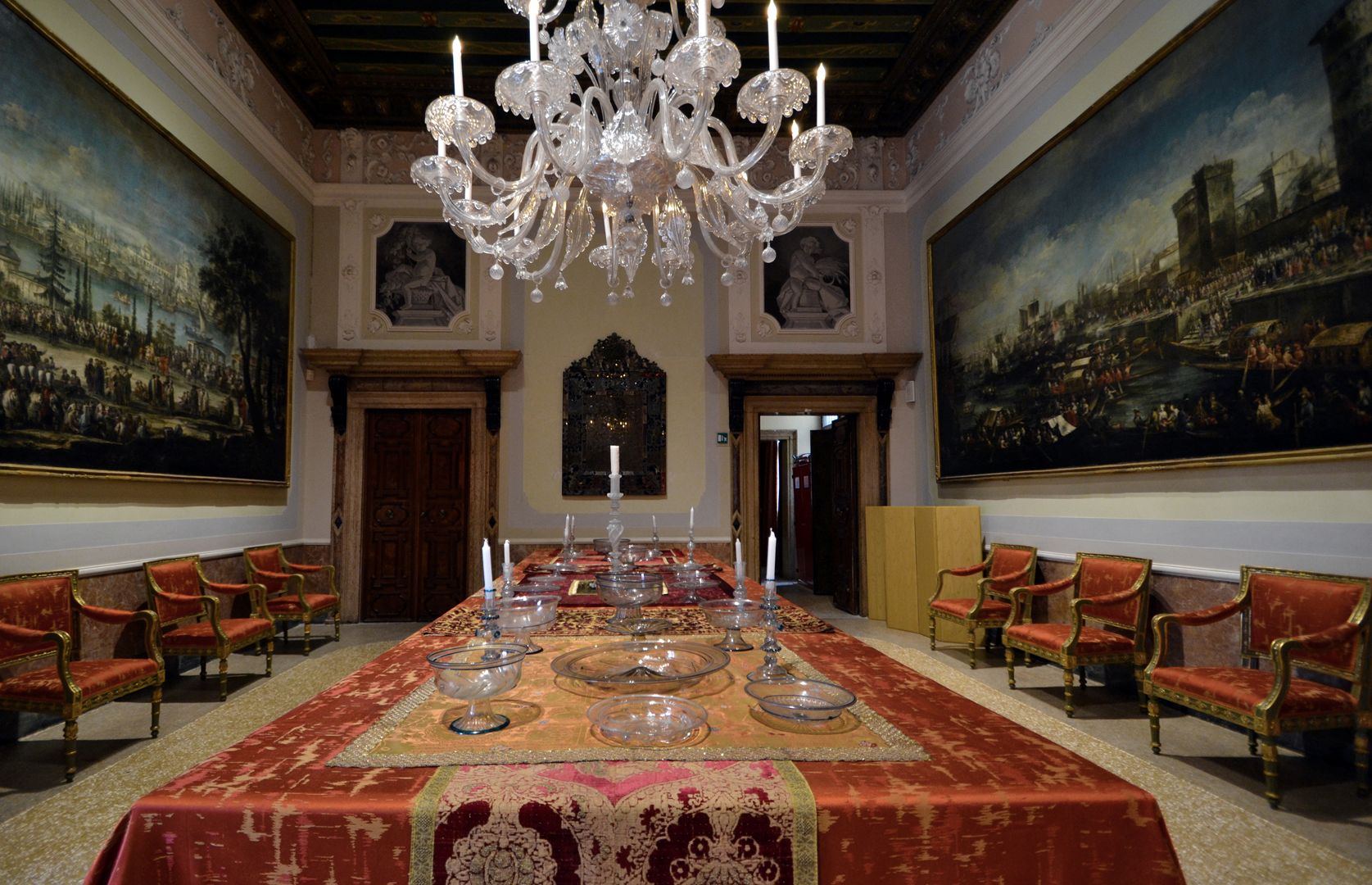
The two monumental canvases recount the diplomatic missions of Alvise II Mocenigo (1668-1725) as ambassador for the Venetian Republic in London, from 1701 to 1705, and as bailo in Constantinople, from 1709 to 1714. The coat of arms of the Mocenigo family appears proudly on the saddle cloths of horses in Constantinople and on gilded carriages in London. There is a curious tradition that interpreted the painting set in London as an Arrival in Chioggia of a prince of Sweden, whereas in reality the artist borrowed from the painting entitled the Arrival of the Venetian ambassadors Nicolò Erizzo and Alvise Francesco Pisani in London on 30 May 1707 by Luca Carlevarijs (1663-1730), an artist recognised as the father of Venetian vedutism.
Set between floral decorations and within stucco frames, there are frescoed grisaille allegories of the four seasons in the overdoors, each represented by a putto bearing, in sequence, flowers, ears of corn, bunches of grapes and fire.
In this spacious reception hall, the courtly atmosphere is evoked by the imposing table majestically set with cups, stands, candlesticks and plates, all of them Venetian-made glass artefacts dating from between the sixteenth and eighteenth centuries.
Room 8
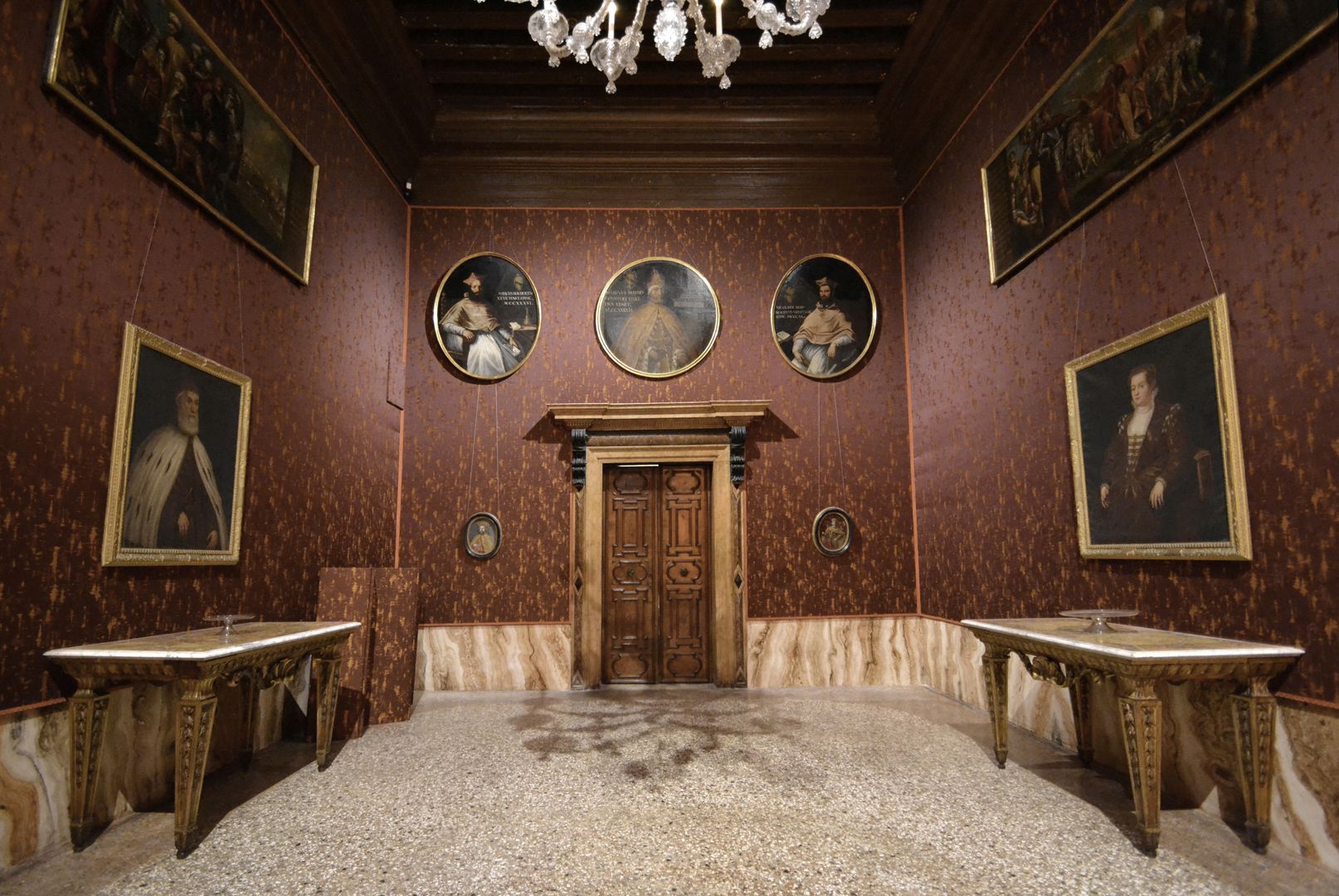
The commemorative portraits displayed here provide a basic narrative of people who lived in eras far removed from those in which they were executed. This is not accidental, but rather indicative of the steadfast and constant desire of the families of the Venetian patriciate to remember personalities and events that enhanced or emphasised the historical importance of their lineage.
Two canvases tell of Tommaso Mocenigo (1343-1423) who in 1396 was commissioned by the Venetian senate to sail with eight galleys to assist the crusaders engaged against the Turks of Sultan Bāyazīd. The fleet managed to free Constantinople from the Ottoman siege and rescue King Sigismund of Hungary with a few other survivors.
Other portraits tell of the fortunes of the Morosini family, which in the thirteenth century spread outside Venice thanks to the marriages of Tommasina to the Hungarian prince Stephen the Posthumous and between Constance and Ladislaus, son of Dragutin, king of Serbia.
From the union of Tommasina and Stephen was born a son who, thanks to his uncle Albertino Morosini and his mother’s brother-in-law Marino Gradenigo, later became King Andrew III of Hungary.
Room 9
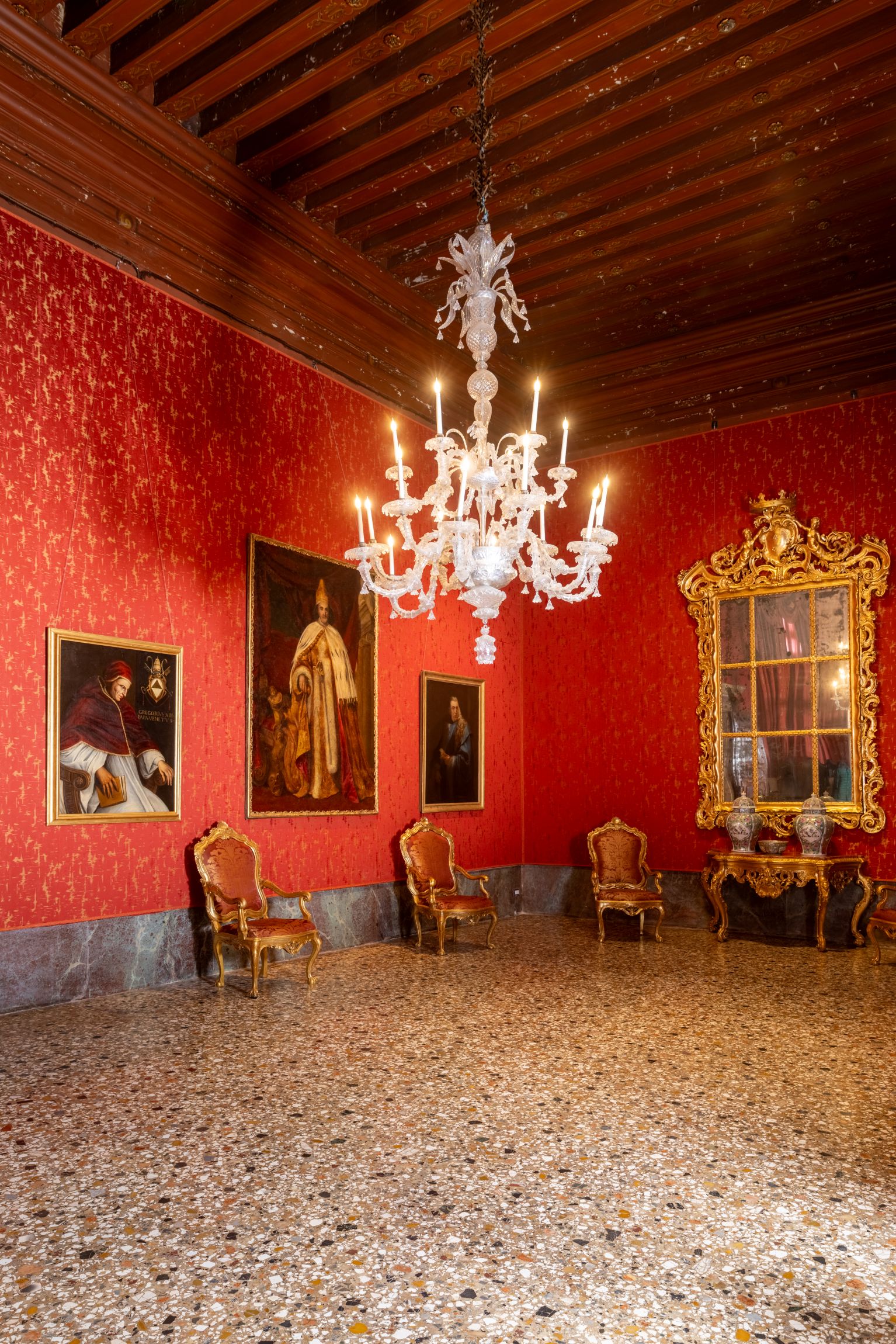
Numerous paintings decorating the walls of the room depict Venetian personalities holding various political offices. The only person depicted who is not part of this large group is the Venetian Pope Gregory XII, born Angelo Correr (ca. 1335-1345 -1417) and remembered because, after being elected to the papal throne in 1406, he abdicated in 1415 in order to help resolve the Western Schism, caused by the co-presence of three popes in office.
A typical episode of ancient Venetian custom is instead narrated in the bas-relief depicting a fight on the Ponte dei Pugni, still located near Campo San Barnaba and formerly without railings. In a fight between two rival factions, the winner was whoever managed to throw the most opponents into the water. Eventually, given the excessive violence that developed over the years, these fights were later abolished.
Lavishly gilded mirrors, consoles and high chairs are part of the palace’s original furnishings. From this room, as from the previous or the next one, one can appreciate the perspective and scenic succession of doors, surrounded by luxurious marble frames.
Room 10
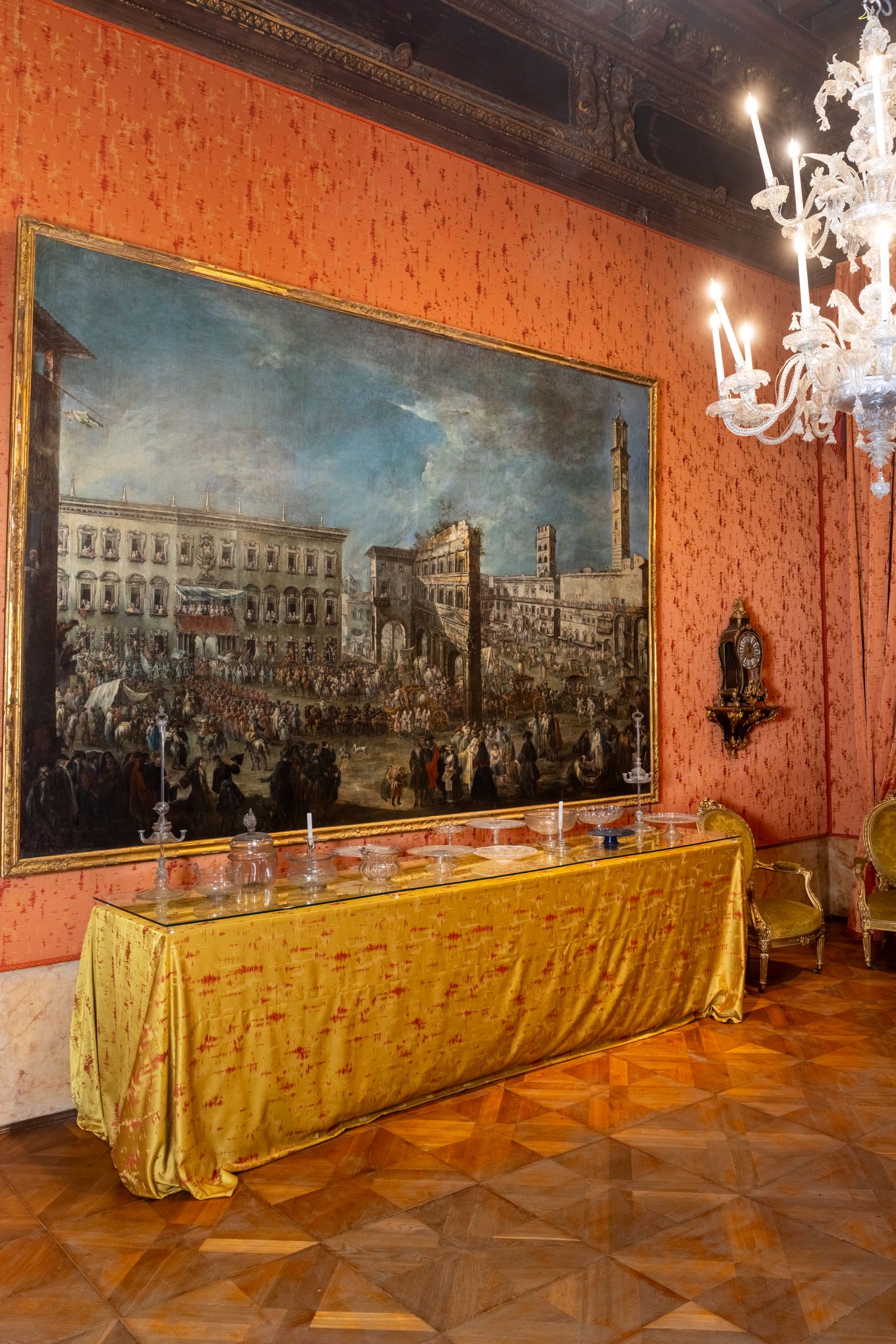
In this room the series of Mocenigo family splendours concludes with three paintings dedicated to Anna Maria Luisa de’ Medici (1667-1743), daughter of Grand Duke Cosimo III of Tuscany and elector of the Palatinate. The last of her dynasty, upon the death of her husband she left Düsseldorf for Florence, her native city, to which she bequeathed the enormous artistic collections of her Medici ancestors with the Patto di Famiglia (‘Family Pact’) of 1737.
During one of the various stops on her long journey, she stayed in Verona as the guest of the Marchese Carlotti.
The larger canvas, depicting the celebratory procession in her honour, is the result of a perspective manipulation that enhances its panoramic magnificence. The positions of Palazzo Carlotti to the left and of Porta Borsari in the centre are correct, but the latter is imaginarily detached from other buildings and shown in direct contact with Piazza dei Signori, which is actually further away, where the Palazzo del Capitanio and the Torre dei Lamberti appear.
Alvise III Mocenigo (1671-1745), then captain in Verona, organised a grand ball in his residence on the evening of 9 October 1717 in honour of the princess. The second painting shows the arrival in the courtyard of the Capitanio’s palace with the insignia of Venetian rule, later obliterated in the patriotic fervour harking back Verona’s independence under the Scaligeri, while the third canvas illustrates the final scene of the ball in a large hall.
On the shelves there are portraits of the wife of the last Mocenigo together with photographs of the Aosta branch of the Savoy royal household.
Room 12
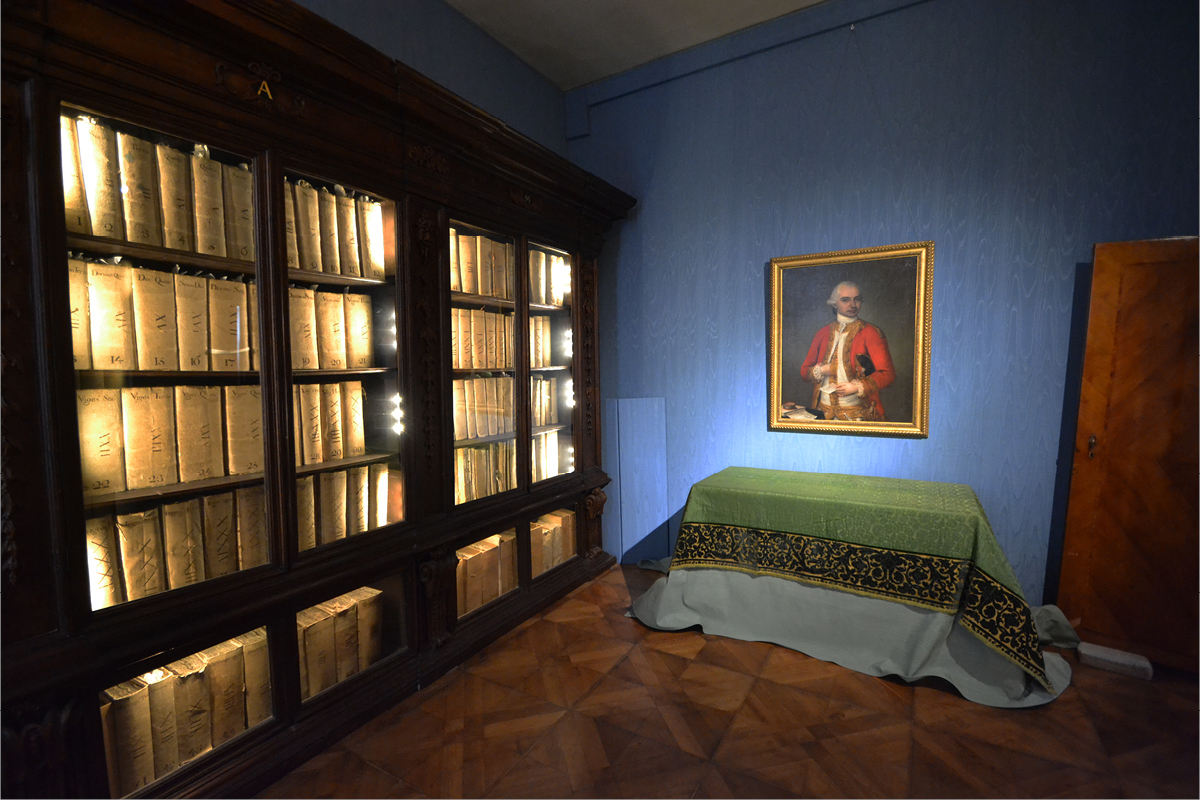
The archives of the Mocenigo di San Stae family, a selection of which is shown here, have survived through the testamentary bequest of Alvise II Nicolò (1871-1953), the last descendant of the Mocenigo family. The documents, which date from the eleventh to the mid-twentieth century, are divided into three large holdings.
First and foremost, the Mocenigo di San Stae holding, which also contains documentation from families whose assets came to the Mocenigo between the sixteenth and seventeenth centuries through marriages and inheritances.
Again through matrimonial and patrimonial aggregations, the Contarini Da Mula di San Beneto holding also became part of the archive, following the marriage in 1771 between Alvise I Mocenigo and Polissena Contarini Da Mula. It is richly endowed with papers concerning the families who joined the household in earlier years.
Lastly, there is the Corner di San Polo holding, which came into existence thanks to the marriage between Alvise I Mocenigo and Laura Corner in 1787.
With regard to the content of the texts, the holdings present the typical composition of other Venetian noble archives, in which administrative, financial and judicial papers relating to family property are juxtaposed and alternated with documents pertaining to the public and political sphere, frequently reflecting the career and civic commitment of family members. And there is also material of a more strictly personal and private nature.
Room 13
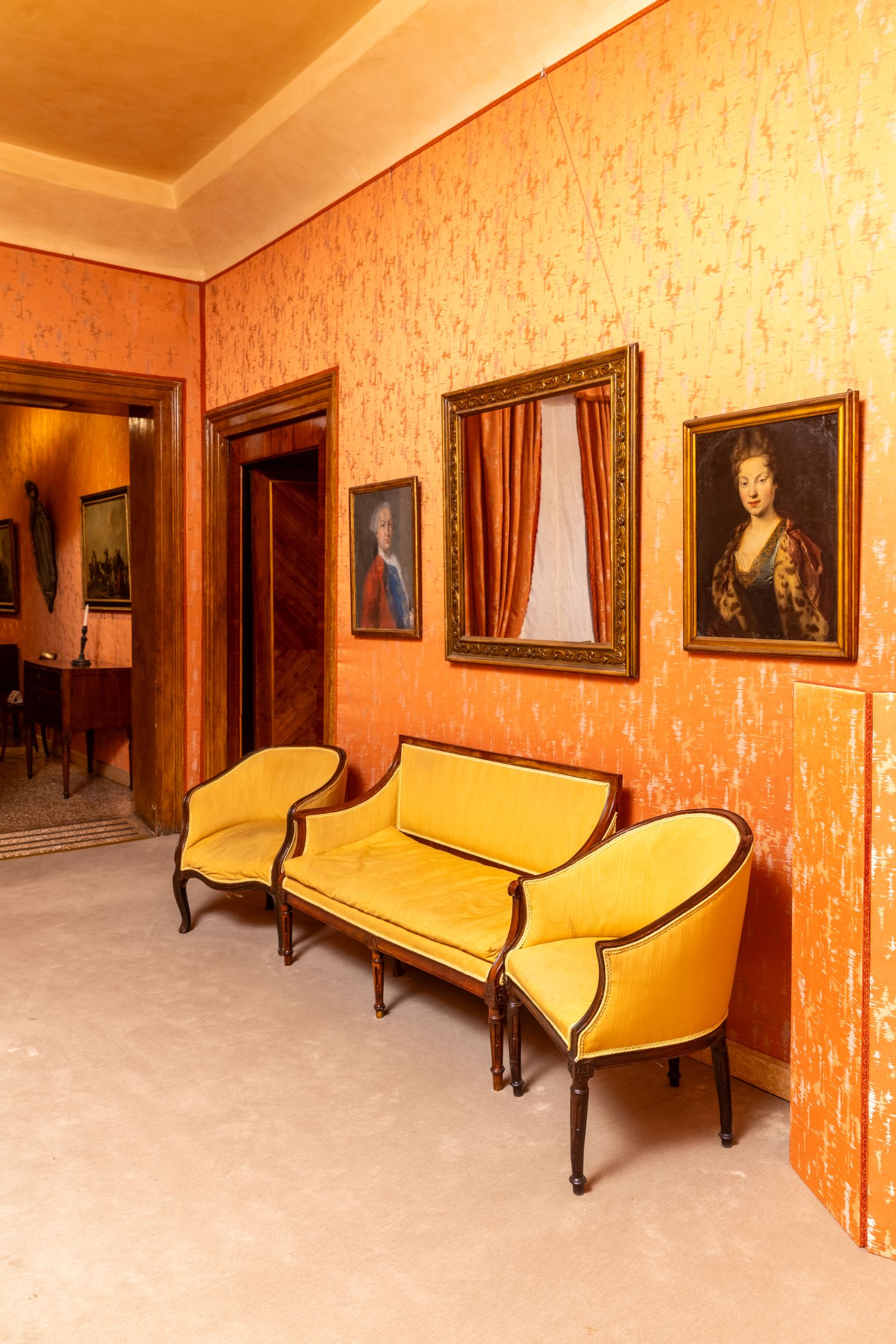
This room leads to the section dedicated to a lesser known but very special and intriguing aspect of Venetian life, that relating to the history of perfume.
A video evocatively recounts the history of the sector since the Middle Ages, along with the secrets of production, the whims of customers and the evolution of taste, clearly underlining how fundamental the contribution of Venice has been to this art.
The apogee of this story unfolded in the sixteenth century, when perfume was all the rage. Among the most picturesque items being made at the time were paternostri, or rosaries made of perfumed paste; moscardini, which were tablets to combat bad breath; uccelletti di Cipro, or fragrant pastes, perhaps in the shape of birds, that could be burned like incense; the lisci and manteche, which included various cosmetic preparations; acqua nanfa, which was a distillate of orange blossoms; and the bionde, or solutions for bleaching Venetian women’s hair.
Leather gloves treated to smother the unpleasant smell of tanning were also famous, although a devious, poison-soaked version of them is also recorded as an all-Italian speciality.
Room 14
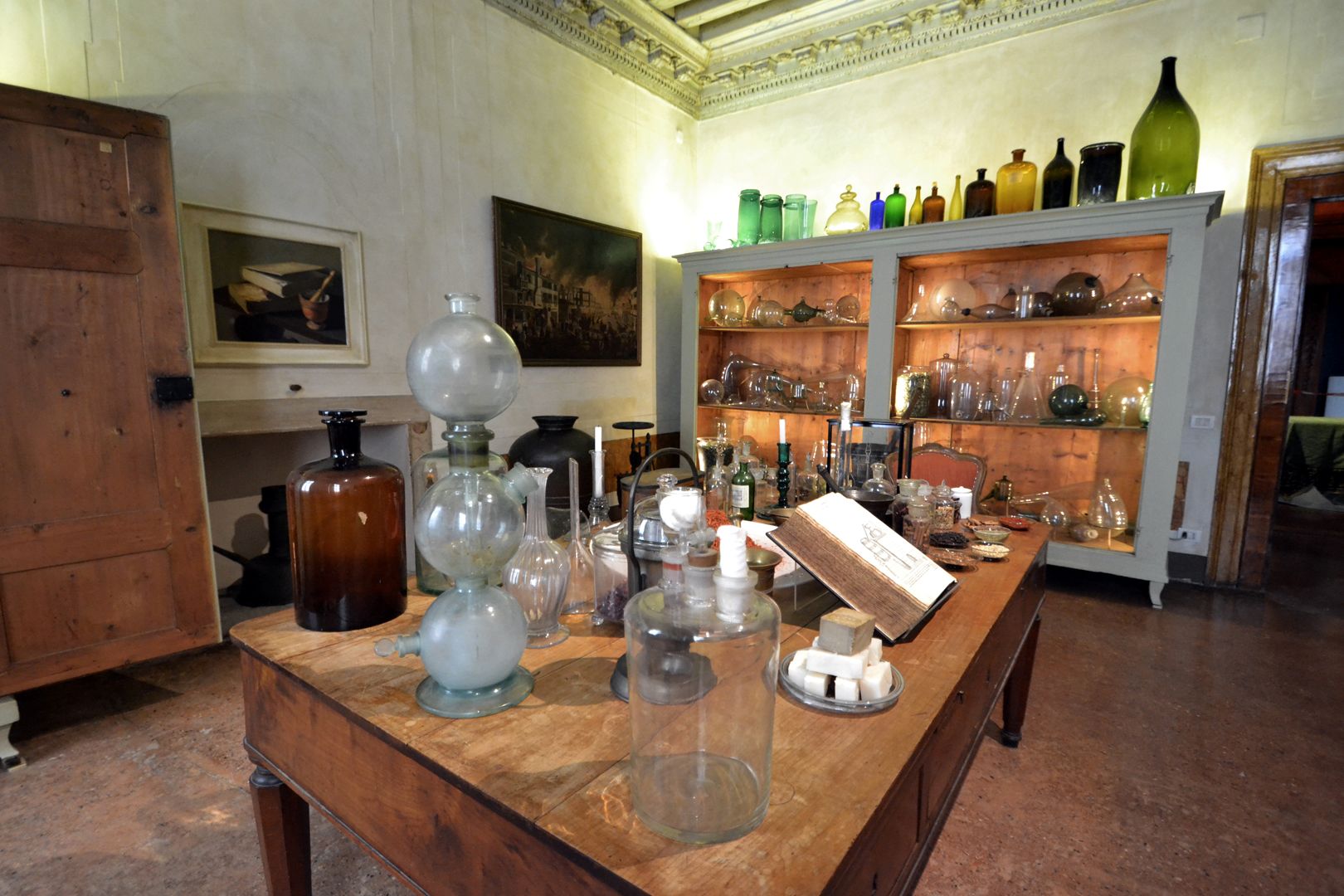
The room evokes the atmosphere of a workshop of a perfumer, once known as a muschiere or ‘musk-maker’; a repository of processes and recipes for creating soaps, oils, pastes, powders and liquids to perfume rooms, bodies, clothes and accessories.
From the last decades of the fifteenth century, a new interest in women’s cosmetics developed in Italy and numerous recipe books and treatises based on the medieval texts were printed, especially in Venice. These books still consisted of heterogeneous blends of medicine and cosmetics, art and science, pharmacopoeia and magic.
In this room, littered with alembics, various containers and apothecary albarello vases, a Venetian edition from 1570 of Commentarii in sex libros Pedacij Dioscoridis Anazarbei de Medica materia […] dominates the table. The work of Pietro Andrea Mattioli (1501-1578), it is the best-known botanical and pharmaceutical text of the sixteenth century, and contains commentaries on the medical work of Dioscorides Pedacius, along with popular notions and the medicinal virtues of hundreds of plants that were unpublished at the time.
The wall panel is an olfactory map tracing the routes travelled by Venetian merchants to procure raw materials through the dense trading networks of the maritime convoys set up by the Venetian state, known as mude. These routes were fundamental for trade and for making Venice one of the capitals of perfumery in the West.
Room 15
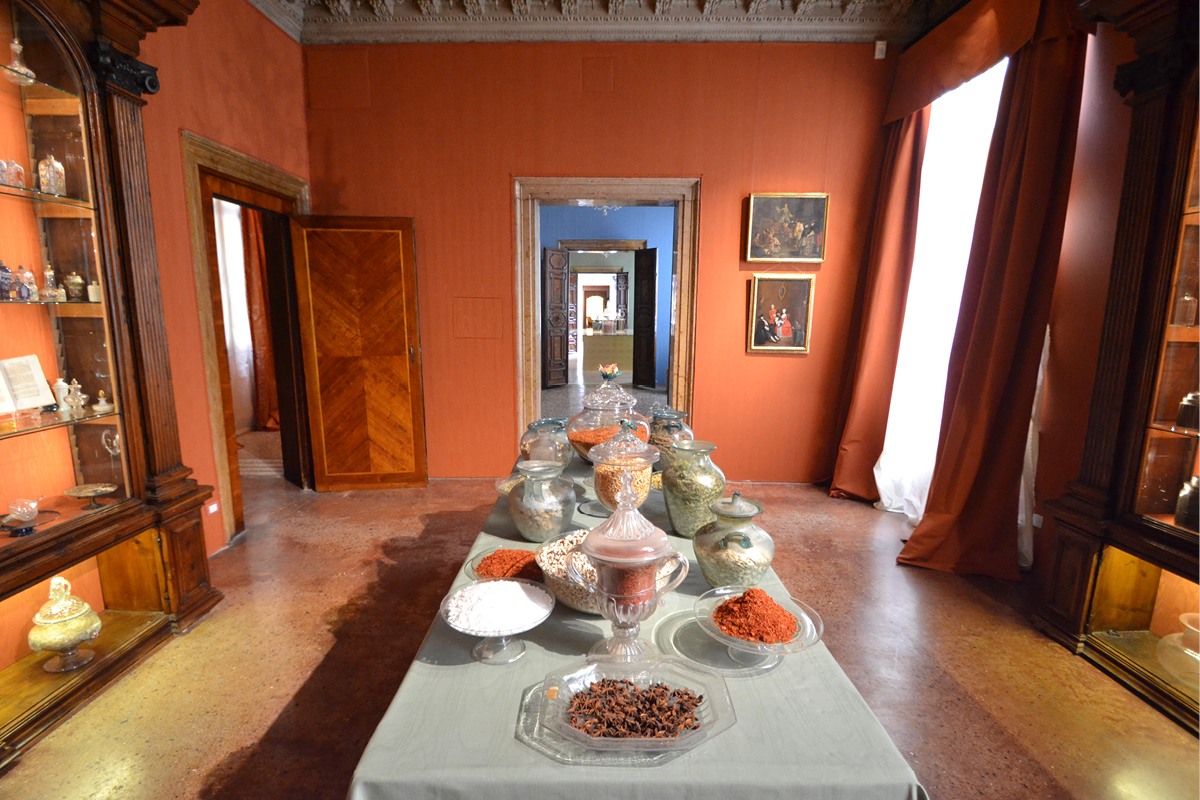
This room is dedicated to the raw materials used in perfume production, most of which were already mentioned in ancient Renaissance recipe books.
Expensive and sought-after, perfumes required rare and exotic raw materials, both of plant origin such as benzoin or cinnamon, and animal origin such as civet and castoreum.
Some were particularly rare: musk, or moscado, for example, a secretion from a hairy pouch near the navel of male specimens of the moschus moschiferus, a mammal belonging to the deer family. Another was ambergris, ambracan, obtained from the intestinal concretions of sperm whales and other cetaceans.
In the two showcases, a selection of antique Venetian glassware is displayed on one side; on the other, among dried plant materials, are the Secreti nobilissimi dell’arte profumatoria, in the 1672 Bolognese reprint of Rossetti’s work, and the Secreti del reverendo don Alessio piemontese, a Venetian reissue of 1783, much later than the first edition of 1555, both belonging to the Vidal Collection.
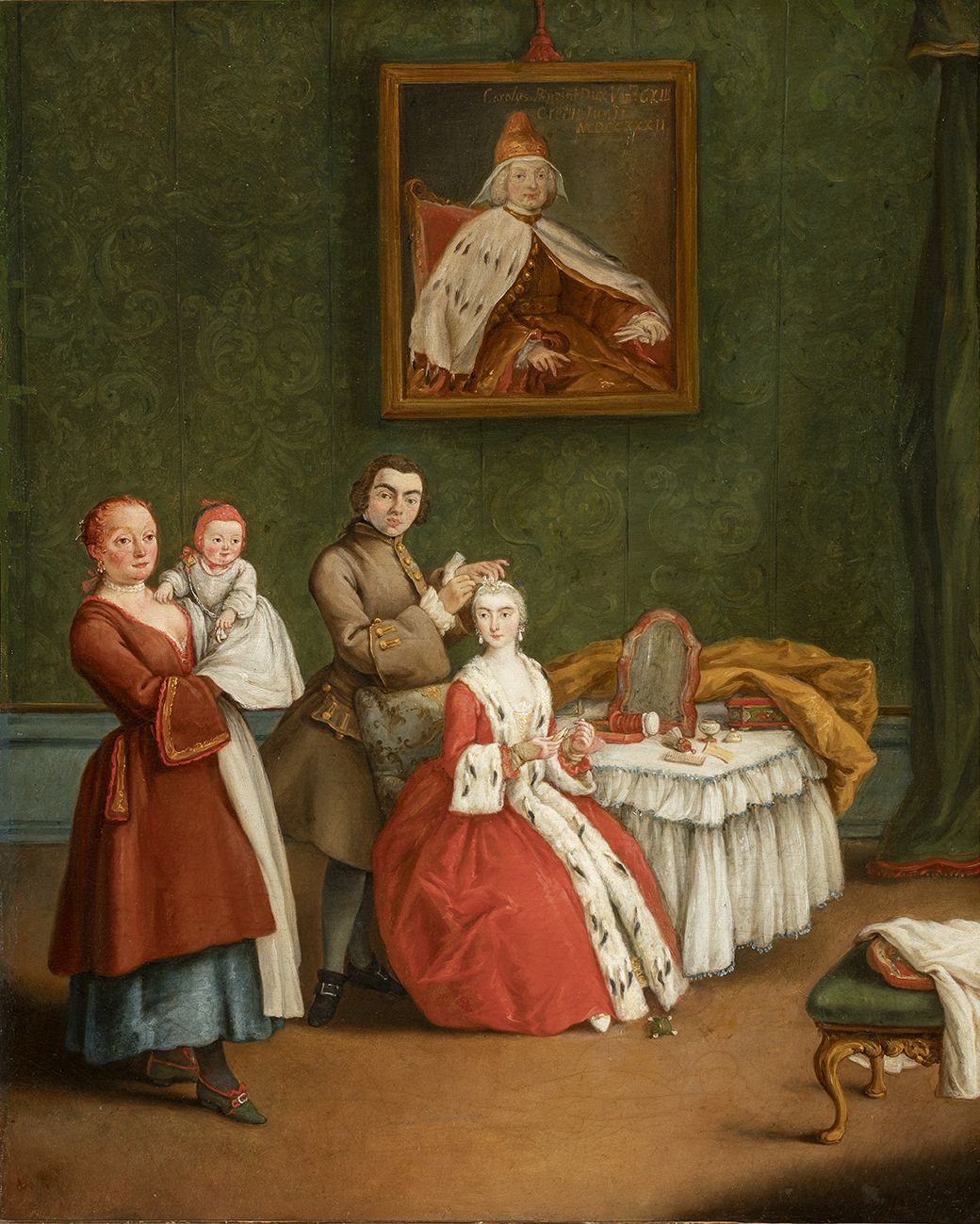
The wall paintings, all of small format, represent themes dear to the repertoire of anecdotal and confidential subjects characteristic of the famous Venetian painter Pietro Longhi. Some of them are explicit eighteenth-century replicas, while others are tackled with a more autonomous pictorial rendering.
Room 16
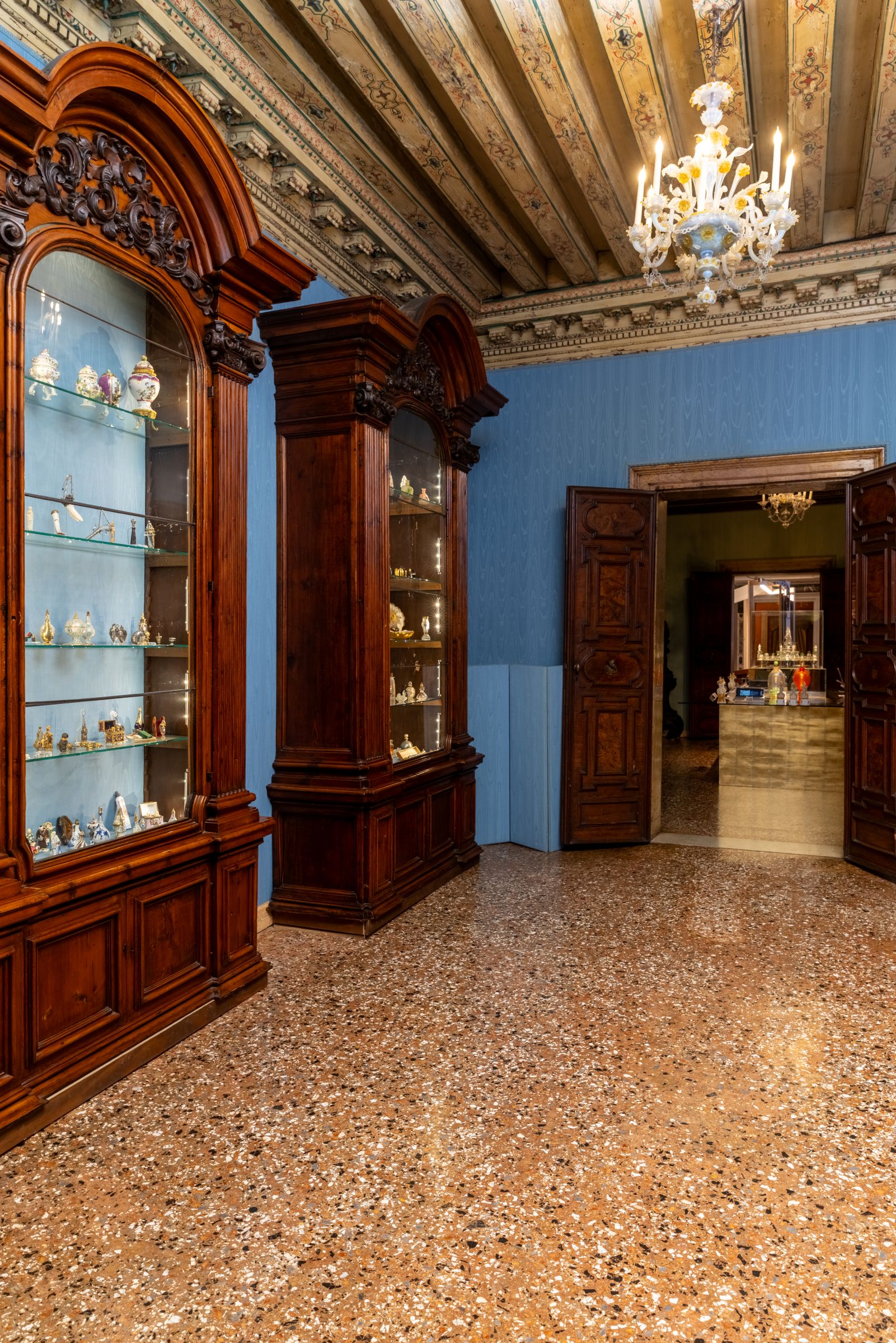
Three showcases, three centuries, three ways of experiencing and interpreting perfume and its containers in cultural, aesthetic and social terms.
The selection exhibited here is on loan from the Storp Collection in Munich.
Showcase 1: the refined splendour of the eighteenth century
In the eighteenth century, perfume was still reserved for a select few, an elite thanks to their title and social position.
The bottles are small and precious and contain limited quantities of fragrant balm or highly concentrated fragrances.
Showcase 2: the solid transparencies of the nineteenth century
The rise of the bourgeoisie greatly increased the number of those using perfume as a finishing touch for their improved personal hygiene.
The nineteenth century was the century of Eau de Cologne filling large, often faceted, coloured glass bottles placed on dressing room shelves along with other cosmetic articles.
Showcase 3: the unique style of the twentieth century
In the twentieth century, perfume was on its way to becoming a mass product. How then to create an elitist product?
The answer lay in a mixture giving rise to the most iconic perfumes of all time, combinations of an exclusive fashion name, a famous glass designer and a great nose, namely, the perfume creator responsible for inventing perfect accords of essences.
One name above all symbolises glass design at the turn of the century: René Lalique.
Room 17
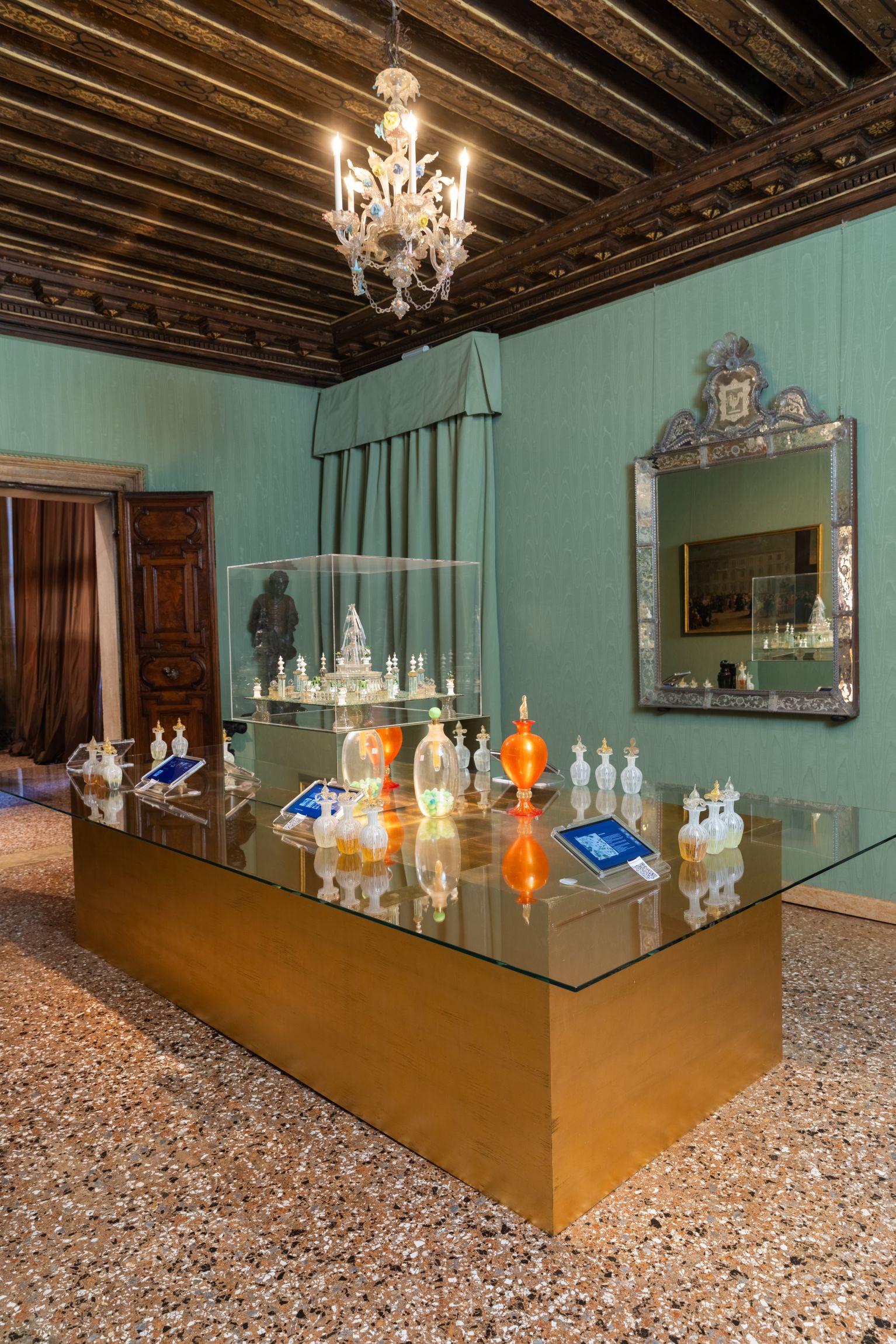
The term olfactory family indicates the modern classification of perfumes based on the elements of which they are composed. On the table, contained in eighteen glass bottles made by hand by Venetian craftsmen, the essences that contribute to the formation of six of the seven main official families are available for the public to sniff.
Visitors can lift the caps to experience the fragrances in an intoxicating way while gleaning useful and interesting scientific information from the associated panels.
The bottles are arranged around a refined eighteenth-century Venetian glass and crystal deser, a precious and triumphant decoration created to enrich the table and impress guests at sumptuous banquets, or as gifts to foreign kings and princes.
The decoration of the room is completed by a pair of imposing nineteenth-century mirrors bearing the symbol of the island of Murano engraved at the top of the frame, together with a painting depicting a carnival scene in St. Mark’s Square in Venice, which is particularly interesting for the multicoloured costumes and bizarre masks depicted, the forerunners of the eighteenth-century bauta outfit that is seen very frequently in Pietro Longhi’s artistic production.
Rooms 18 and 19
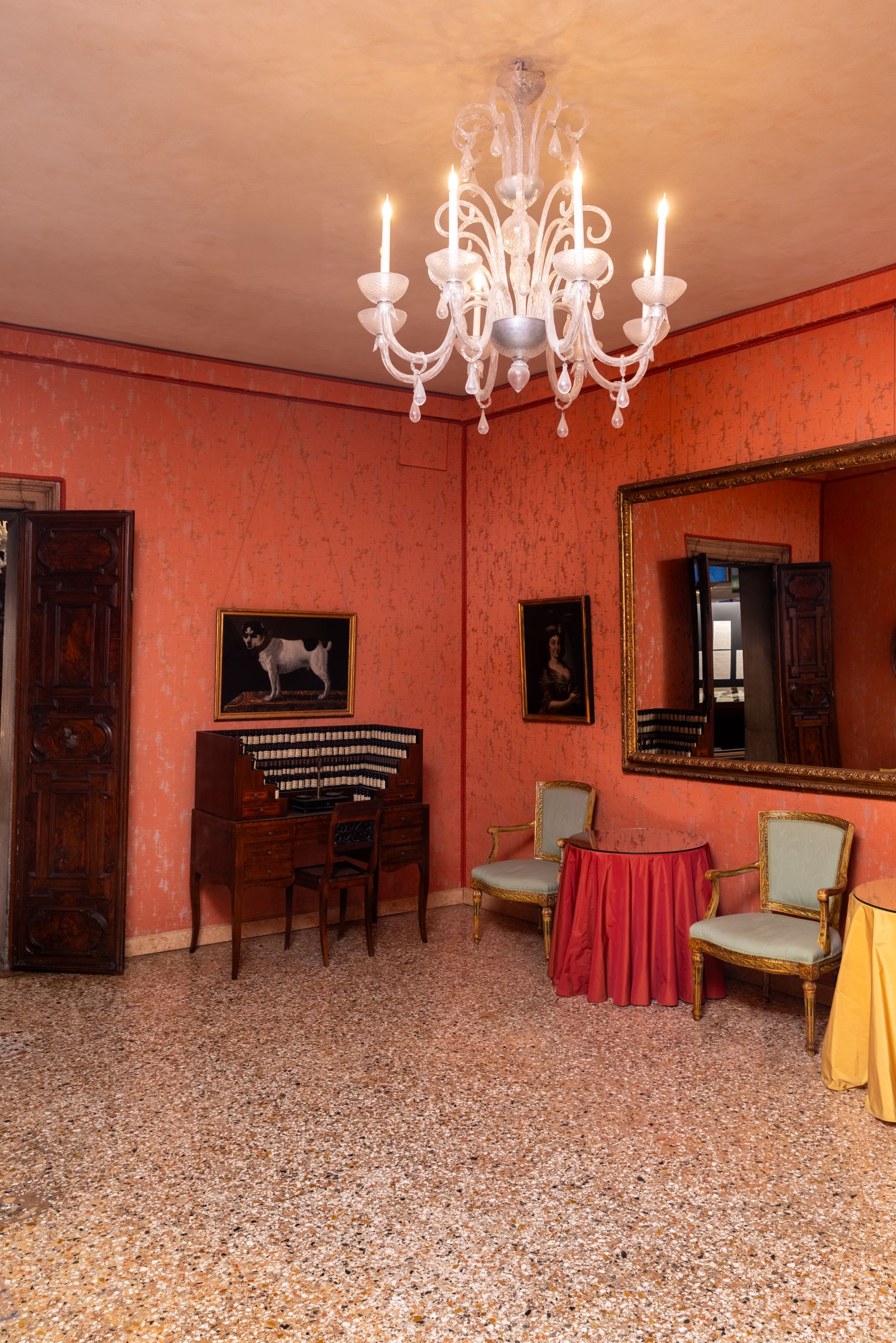
The protagonist of room 18 is the ancient and rare organo da profumiere – literally an ‘organ for perfumers’ – an extraordinary and peculiar piece of furniture used by a master perfumer to compose his creations from over two hundred bottles of essential oils, here lined up like spectators seated on the cavea of an antique theatre.
On the walls, together with the curious and bizarre portrait of a tiny pet dog, there are portraits of women; thanks to their different hairstyles and more or less dishevelled clothing, they testify to some of the variations in the fickle fashions to be seen the turn of the seventeenth and eighteenth centuries.
Room 19 is set up as a small gallery of Old Master paintings, with genre or sacred scenes, plus a small portrait of a Venetian lady from the late Renaissance, recognisable and datable by the characteristic and eccentric hairstyle of ringed and wavy locks, as well as by the conspicuous neckline of her dress.